There’s a reason why New York City is one of the world’s shopping capitals – so many of America’s best-known shopping destinations got their start there. Stores like Bloomingdale’s, Tiffany’s, and F.A.O. Schwarz are all synonymous with high-end shopping, and the final resting places of their founders can be found in some of the city’s most notable cemeteries. Some of the retailers are buried in simple and modest graves, while others are entombed in grand mausoleums, much like the stores they created.
Here’s a look at the burial places of ten of America’s most notable retailers.
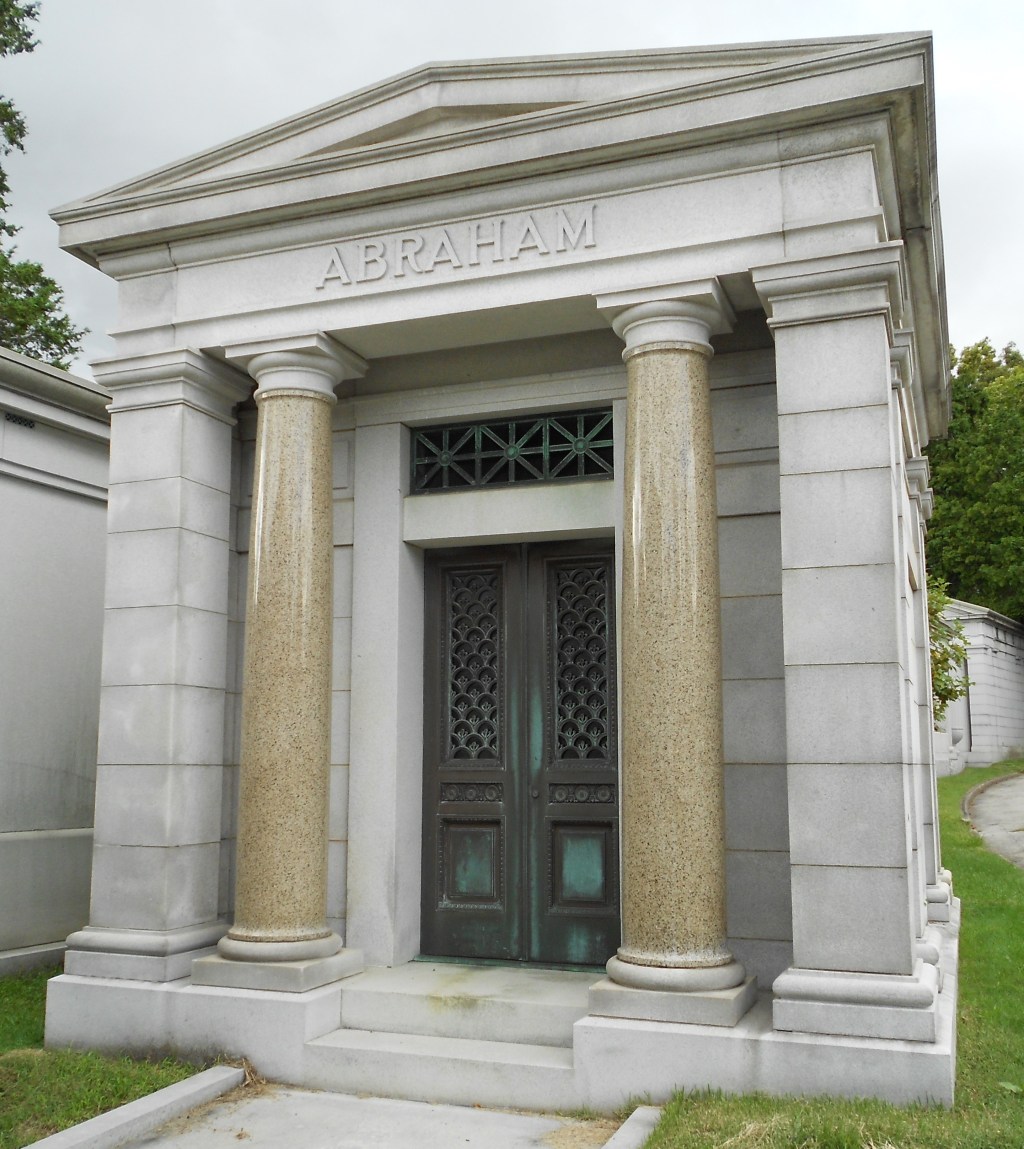
Abraham Abraham – Salem Fields Cemetery, Brooklyn, New York
Abraham & Straus began as a small dry goods store in 1865 and quickly became one of New York’s most popular department stores. Its flagship store on Fulton Street, in downtown Brooklyn, was known for its elegance and catered to the elite carriage trade.
When company cofounder Abraham Abraham (whose parents lacked obvious creativity in naming him) died in 1911, newspapers reported the cause of death as a “sudden attack of acute indigestion.” On the day of his funeral, all the Abraham & Straus and Macy’s (owned by Abraham’s business partners Isidor and Nathan Straus) locations were closed for the day. Other retailers drew their blinds, as a contingent of more than 50 honorary pallbearers escorted Abraham’s casket into Brooklyn’s Temple Israel for the religious service. They were led by New York City Mayor Jay Gaynor, who also gave the eulogy.
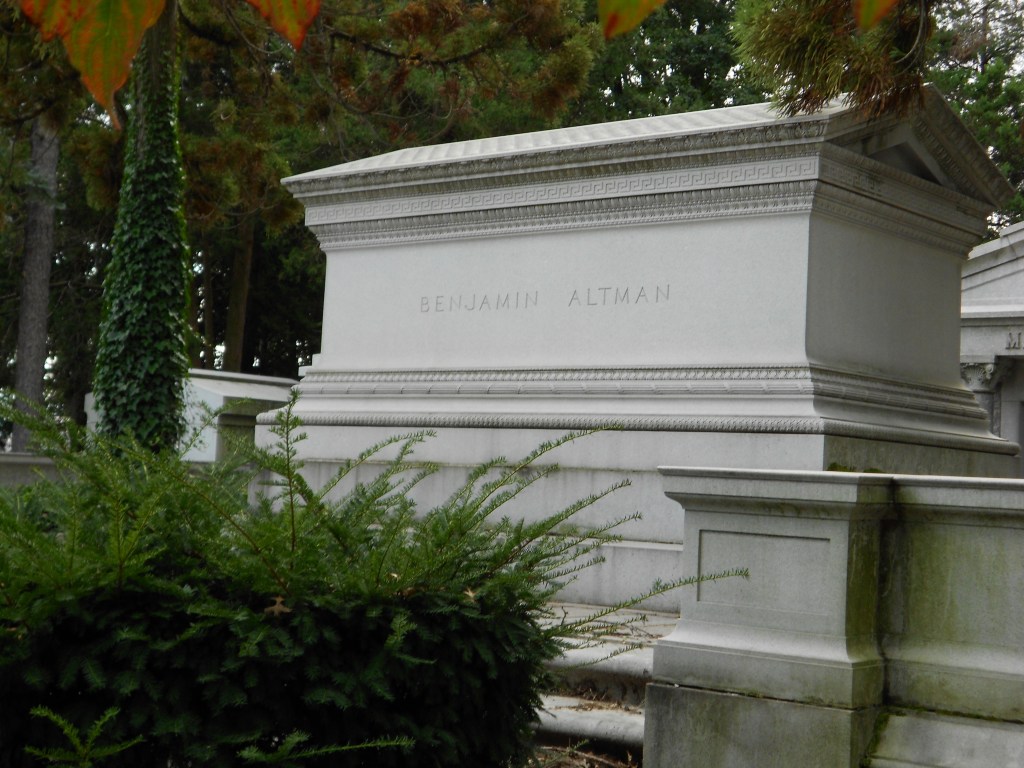
Benjamin Altman – Salem Fields Cemetery, Brooklyn, New York
B. Altman and Company, one of New York’s first department stores, was opulent and extensive. Besides Waterford crystal and Oriental rugs, it offered a spacious salon for mourning attire. In 1911, the Millinery Trade Review noted that Altman devoted most of its window space to mourning goods.
When Benjamin Altman, the store’s founder, died in 1913, thousands lined the streets to witness his funeral procession. Two years later, Altman’s granite tomb was dedicated in a ceremony attended by B. Altman employees. Designed by the New York architectural firm of Trowbridge and Livingston, which also designed Altman’s flagship store, the monument is ornamented by a Greek key motif and rests upon a platform at the center of an oval space, surrounded by mausoleums and flanked by pine trees. In 1985, Altman’s flagship store was designated a New York City landmark. The building now houses a branch of the New York Public Library.
Henri Bendel – Kensico Cemetery, Valhalla, New York
Louisiana native Henri Bendel opened Henri Bendel, Inc. in 1895. Before long, his fashionable store on Manhattan’s Fifth Avenue was a destination for the rich and famous, who came to browse Bendel’s selection of imported French fashions, including those of Coco Chanel. As the years passed, Bendel’s moved with the times, employing a young pop artist, Andy Warhol, as an in-house illustrator in the 1960s and, more recently, serving as a filming location for the HBO hit Gossip Girl.
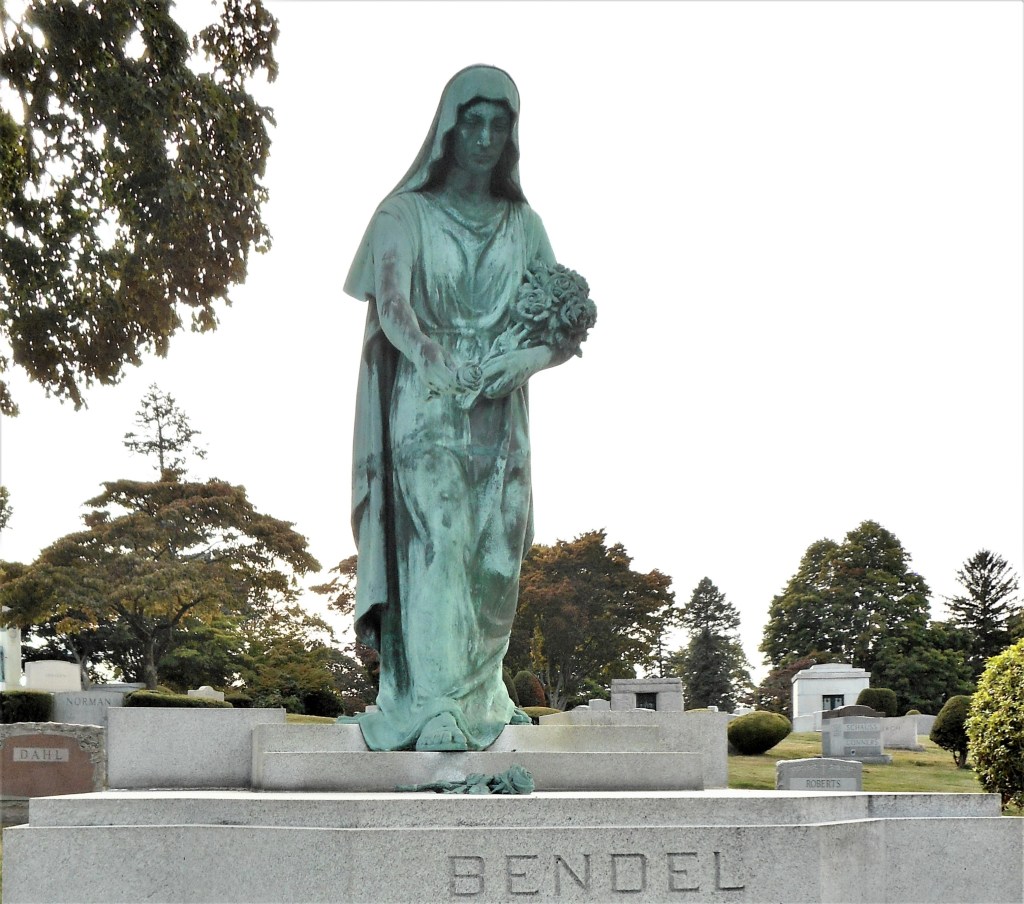
Bendel’s grave, on Pocantico Avenue, features a bronze statue of a woman casting roses onto a granite pedestal. Also buried there is his friend A. Beekman Bastedo, who led the store after Bendel’s death.
Though the store closed in 2018, Bendel’s iconic brown-and-white boxes and bags will always evoke its brand.
Lyman Bloomingdale – Salem Fields Cemetery, Brooklyn, New York

The luxury department store, which was founded by brothers Lyman and Joseph Bloomingdale, celebrated its 150th anniversary in 2022. Its longevity more than disproves the prediction of rival retailers, upon its opening in 1872, that the store “wouldn’t last a year.”
With over three dozen U.S. locations, the flagship on Lexington Avenue and 59th Street attracts shoppers worldwide. In 1976, Queen Elizabeth and Prince Philip made a visit. For their bicentennial visit, traffic on Lexington Avenue was reversed so the Queen could exit from the right, per protocol.
When Bloomingdale died in 1905, The New York Times reported that his funeral “was one of the largest ever held in the Jewish community.” In a sign of how widely respected he was, the newspaper felt compelled to note that “there were also a number of Christians present.”
Bloomingdale’s Doric-columned mausoleum, designed by McKim, Mead & White, is in Salem Fields, where he died. His brother Joseph, who died a year earlier, is entombed in Linden Hill Cemetery, Queens.
Max Fortunoff – Mt. Ararat Cemetery, Lindenhurst, New York
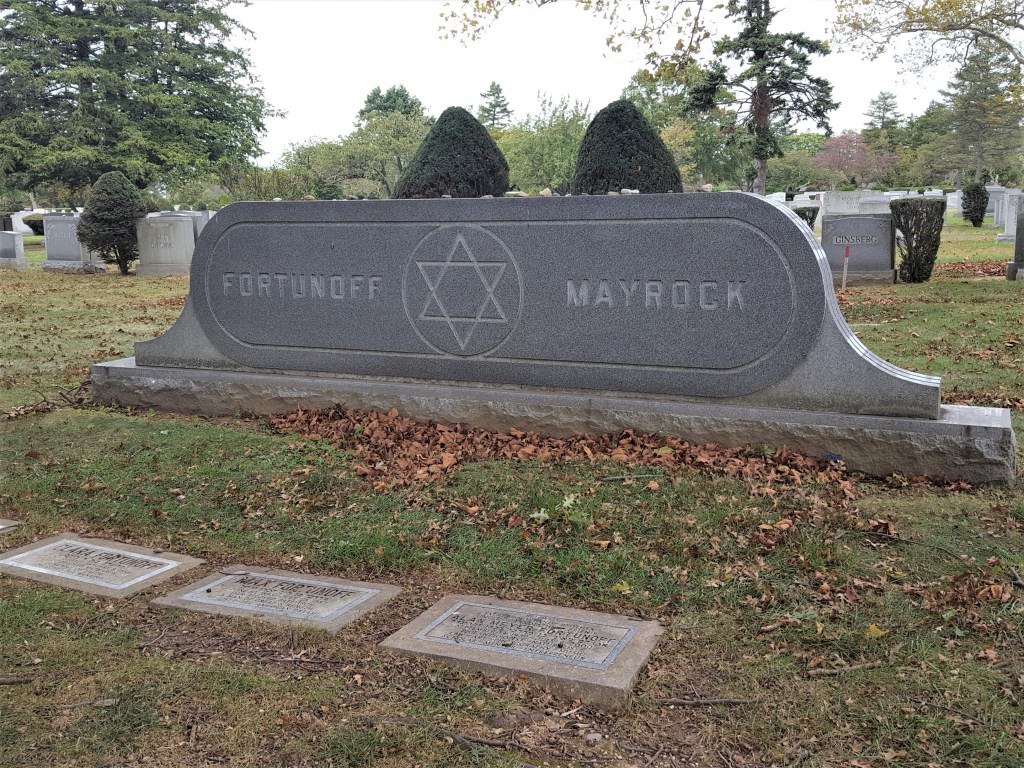
The name Fortunoff is a significant one, especially for Long Islanders. Generations of shoppers could always find the perfect gift there for any occasion. From fine jewelry to backyard furniture, Fortunoff’s in Westbury had it all. The company’s founders, Max and Clara Fortunoff, began their business in Brooklyn by selling housewares . In 1964, the couple relocated their business to Long Island, where the store gained a reputation for its exceptional customer service, competitive prices, and extensive selection.
The Fortunoff family plot is located under a massive tree on a shady corner, at the far end of the cemetery. Max Fortunoff’s footstone reads: He Lived the American Dream. It is a fitting tribute to a man who built an iconic institution on Long Island.
Rowland H. Macy – Woodlawn Cemetery, Bronx, New York

Macy’s is an American institution, founded by Rowland Hussey Macy in 1858. Once known as “The World’s Largest Department Store,” Macy’s Herald Square – which occupies an entire city block in Manhattan — continues to be a shopping mecca for New Yorkers and tourists alike. R.H. Macy began the Christmas window tradition, a concept soon followed by other retailers, and was the first department store to have an in-house Santa Claus. Since 1924, the Macy’s Thanksgiving Day Parade has heralded the start of the holiday season. (LINK 12) When Macy died, his New York Times obituary noted, “From comparatively nothing he became one of the best-known and most successful merchants of the day.”
Despite his tremendous success, with hundreds of locations across the United States, his final resting place is surprisingly understated. The monument itself is a columned structure, topped by a granite urn. Inscribed on its base are the words: “The memory of the just is blessed.”
Frederick August Otto Schwarz – Green-Wood Cemetery, Brooklyn, New York
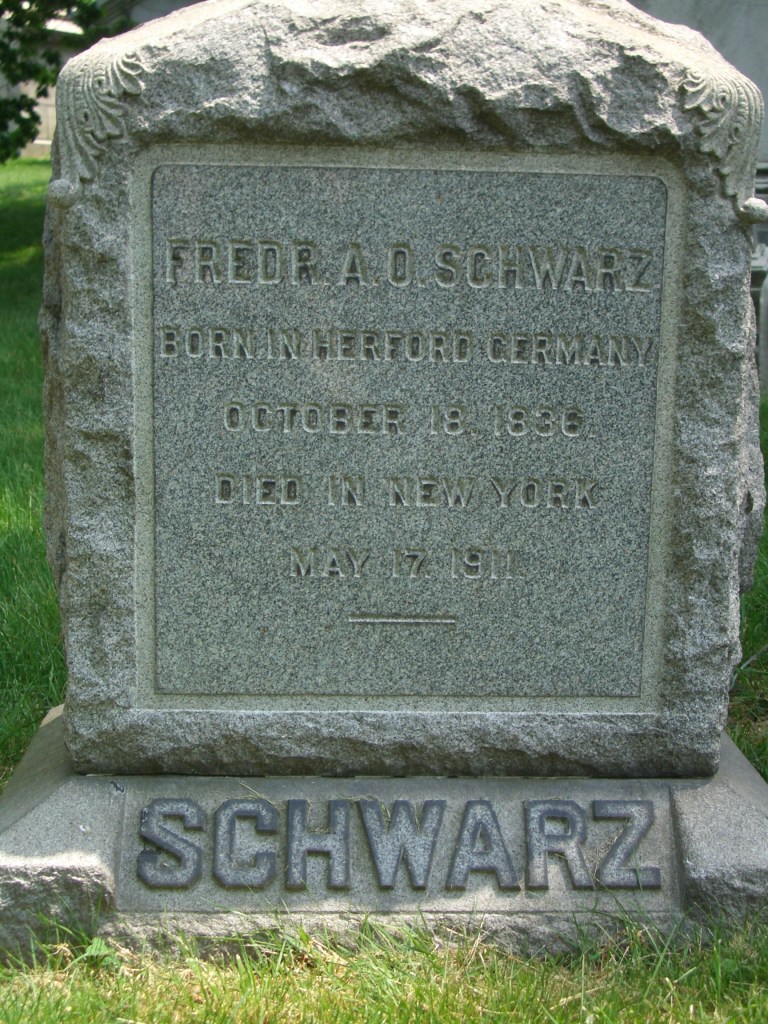
Frederick August Otto Schwarz founded F.A.O. Schwarz, a renowned toy store, with a Fifth Avenue location that featured employees dressed as toy soldiers and elaborate window displays, attracting both children and adults. The store became a destination known for its selection of unique toys and plush animals, and was considered an experience as much as a retail space. The store became a popular backdrop for movie scenes, most notably 1988’s Big, in which actors Tom Hanks and Robert Loggia do a memorable dance on the store’s giant piano. It closed its doors in 2015.
Schwarz, who was inducted posthumously into the Toy Industry Hall of Fame in 2012, died from hepatitis in 1911. But F.A.O. Schwarz, the oldest toy store in the United States, was given a new lease on life when it reopened in 2018 in Rockefeller Center.
Isidor Straus – Woodlawn Cemetery, Bronx, New York
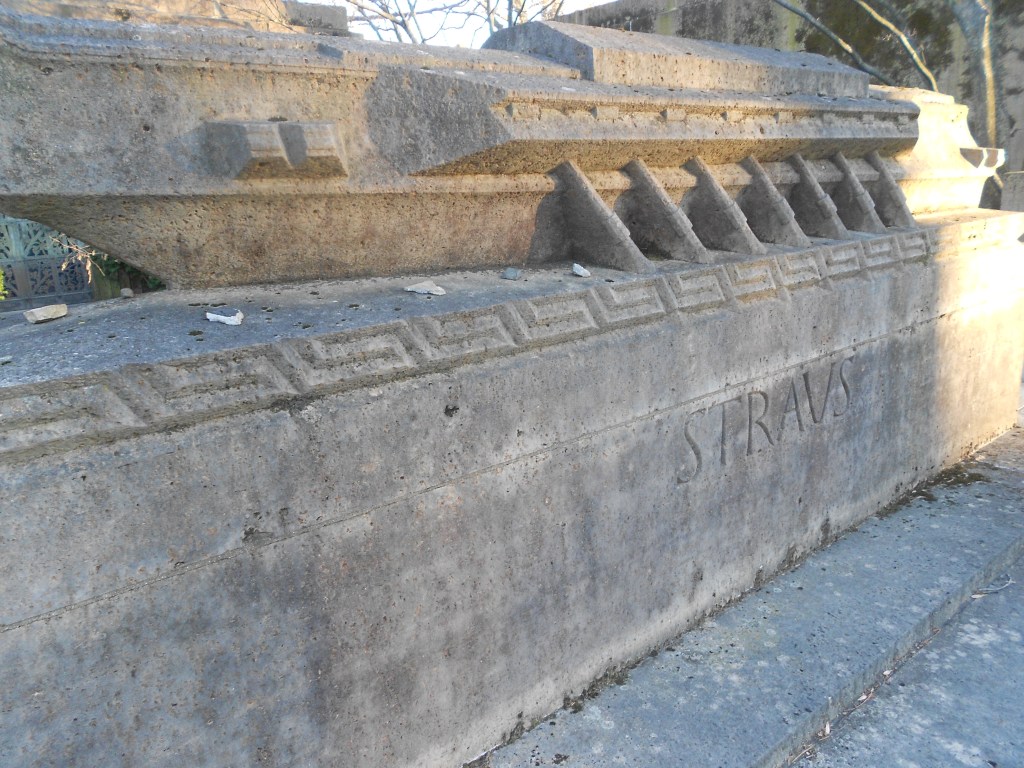
The Straus Memorial on Myosotis Street is one of the most arresting sites in Woodlawn Cemetery. Designed by noted architect James Gamble Rogers, the memorial comprises three separate mausoleums joined together by a common courtyard. In the foreground, a sarcophagus in the shape of an Egyptian funeral barge symbolizes the transport of the dead into the afterlife. It also contains the remains of Isidor Straus, a partner in both Abraham & Straus and Macy’s, and serves as a cenotaph for his wife, Ida, whose body was never recovered. The couple perished together on April 15, 1912, in the RMS Titanic disaster.
Etched into the memorial are these words from the Song of Solomon, which serve as a testament to the indestructible love and devotion the couple shared: Many waters cannot quench love, neither can floods drown.
Charles Lewis Tiffany – Green-Wood Cemetery, Brooklyn, New York

Tiffany & Company’s little blue box is an American symbol of luxury and elegance. One of the world’s most iconic jewelers, the company was founded by Charles Tiffany in 1837, boasting a long and storied history. For decades, it has played a part in pop culture in books, movies, and songs, from Truman Capote’s book, ‘Breakfast at Tiffany’s,” which spawned a movie by the same name, to the 1995 song by rock band Deep Blue Something, to a recent ad featuring Beyoncé and Jay-Z. Famed writer F. Scott Fitzgerald was a Tiffany customer, so it was fitting that the company partnered with the producers of the 2013 remake of The Great Gatsby to create custom pieces worn by the actors.
When Tiffany turned 90 on February 15, 1902, his employees presented him with a gold loving cup inscribed with the words: May your remaining years be blessed and filled with the peace which passeth all understanding. Tiffany died three days later. Buried just steps away is his son, the stained-glass artist Louis Comfort Tiffany.
Franklin W. Woolworth – Woodlawn Cemetery, Bronx, New York

It took a lot of nickels and dimes to pay for the grand, Egyptian-themed mausoleum in which Woolworth founder Franklin Winfield Woolworth is entombed. But with more than a thousand F.W. Woolworth five-and-ten-cent stores around the world, it should have been easily affordable.
Designed by architect John Russell Pope, whose works include the Jefferson Memorial and the National Archives, the Woolworth mausoleum features two guardian sphinxes, Egyptian carvings, columns, and bronze doors depicting figures exchanging an ankh, the Egyptian symbol for life. Sharing the space with Woolworth is his granddaughter and heir, Barbara Hutton. Known as the “poor little rich girl,” Hutton was a socialite who, despite seven marriages, never found her happily ever after. Both Woolworth and Hutton died at the age of 66. Woolworth in 1919, and Hutton in 1979.
 The Morte Girls